Enterprise Knowledge Assistant Operating Model Review

Review, discuss, approve, and prepare implementation from the same generated operating model artifacts already produced by the Models platform.

Executive ModeDecision package ready for section review

4 of 10 sections reviewed

Business
Knowledge access and answer quality
Risk
1 section blockers
Timeline
Approve sections before implementation
Cost
Review against delivery phase
Decision
Approve, reject, or request revision
Mode
Reviewer role
Draft status

Device-local draft is ready.

Role based only. No identity system.

Embedded CanonDraw

The CanonDraw architecture stays inside the review flow so architecture, runtime, policy, cost, risk, and implementation decisions share the same evidence boundary.
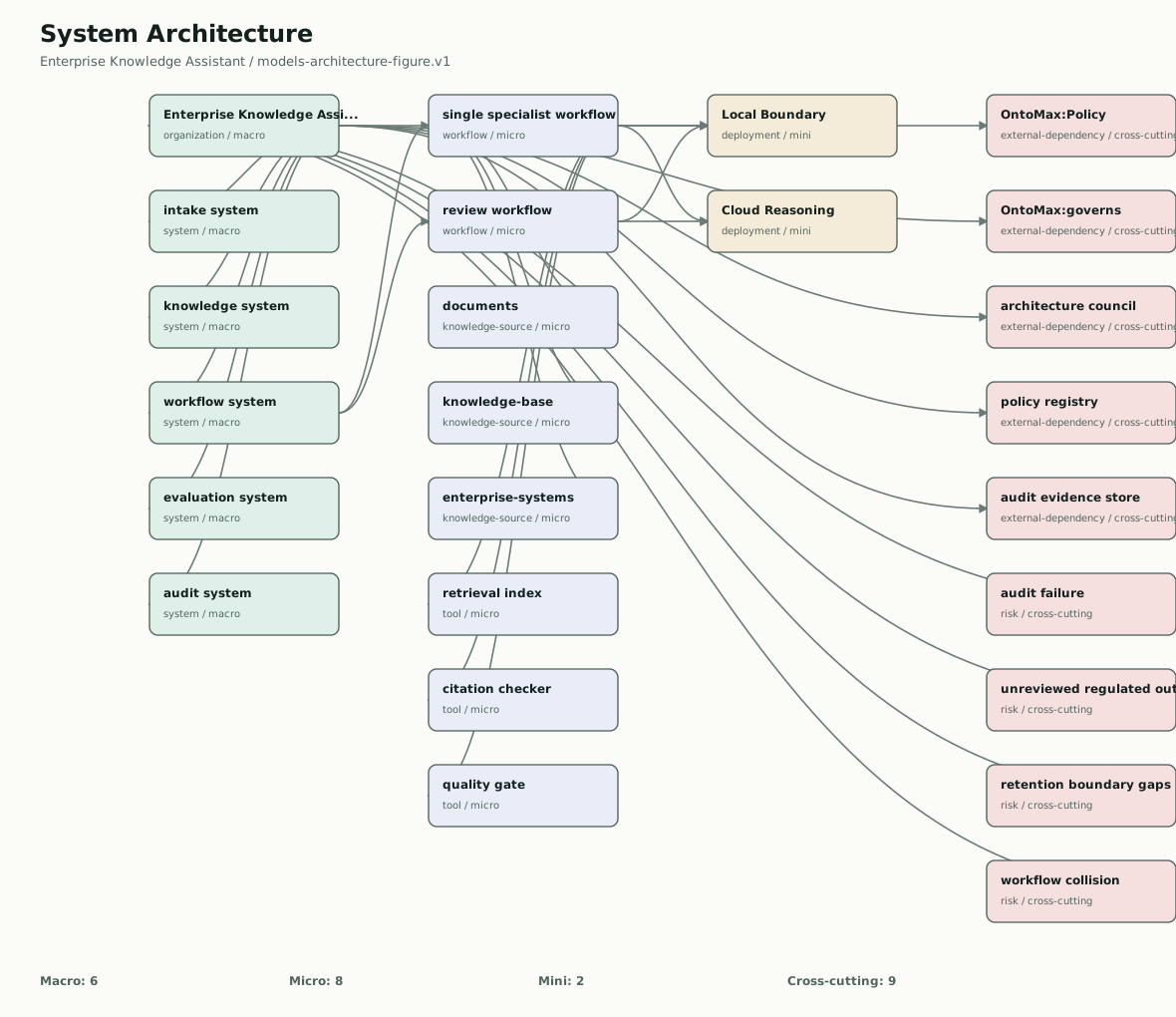
Embedded CanonDraw architecture for the review workspace
Evidence Explorer: origin CDX-MODELS-002, ontology models-architecture-figure.v1, recommendation review-ready.

Current Operating Model

Before

Pilots run through team-local evaluation and exportable reports.

After

Current state is visible as the baseline for every decision.

Difference

Reviewers can approve the factual baseline before discussing target changes.

Why? Show evidence, rules, assumptions, dependencies
Origin
CDX-MODELS-016, CDX-MODELS-024
Rule
Operating model source snapshot 1.0.0
Ontology
opermodel-operating-model-assessment.v1
Recommendation
Keep baseline findings explicit and separate from recommendations.
History
Generated 2026-07-12T14:00:00.000Z from the assessment delivery package.
Dependencies
CanonDocs, CanonDraw, diagnostic, governance, validation, and implementation artifacts.

Target Operating Model

Before

Target state appears inside generated report sections.

After

Target roles, controls, runtime, and delivery path are reviewed side by side.

Difference

Executives can see what must change before they approve implementation.

Why? Show evidence, rules, assumptions, dependencies
Origin
CDX-MODELS-016, CDX-MODELS-024
Rule
Diagnostic and operating model rules
Ontology
opermodel-operating-model-assessment.v1
Recommendation
Advance target model only after accountable owners are named.
History
Generated 2026-07-12T14:00:00.000Z from the assessment delivery package.
Dependencies
CanonDocs, CanonDraw, diagnostic, governance, validation, and implementation artifacts.

Operating Model Delta

Before

Gaps require reading across reports.

After

Before, after, and difference are the primary UI for every section.

Difference

The workspace makes change impact reviewable without opening multiple files.

Why? Show evidence, rules, assumptions, dependencies
Origin
CDX-MODELS-016
Rule
Delta derived from current and target operating model outputs
Ontology
opermodel-operating-model-assessment.v1
Recommendation
Resolve governance and runtime deltas before implementation starts.
History
Generated 2026-07-12T14:00:00.000Z from the assessment delivery package.
Dependencies
CanonDocs, CanonDraw, diagnostic, governance, validation, and implementation artifacts.

Runtime

Before

Runtime decisions are captured as implementation evidence.

After

Runtime ownership, approval gates, and validation are attached to the review.

Difference

Architecture choices become operating commitments instead of notes.

Why? Show evidence, rules, assumptions, dependencies
Origin
CDX-MODELS-008, CDX-MODELS-022
Rule
Validation and readiness rules
Ontology
opermodel-operating-model-assessment.v1
Recommendation
Treat runtime launch as a governed readiness checkpoint.
History
Generated 2026-07-12T14:00:00.000Z from the assessment delivery package.
Dependencies
CanonDocs, CanonDraw, diagnostic, governance, validation, and implementation artifacts.

Governance

Before

Policy appears in the governance report.

After

Authority, rules, assumptions, and approval path are visible in place.

Difference

Reviewers can approve governance independently from engineering detail.

Why? Show evidence, rules, assumptions, dependencies
Origin
CDX-MODELS-017
Rule
Governance policy rules v1
Ontology
opermodel-operating-model-assessment.v1
Recommendation
Keep human approval, audit trail, classification, and export provenance required.
History
Generated 2026-07-12T14:00:00.000Z from the assessment delivery package.
Dependencies
CanonDocs, CanonDraw, diagnostic, governance, validation, and implementation artifacts.

Cost

Before

Cost is packaged in the executive decision artifact.

After

Cost exposure is reviewed with timeline, risk, and implementation impact.

Difference

Budget decisions become part of the approval record.

Why? Show evidence, rules, assumptions, dependencies
Origin
CDX-MODELS-020
Rule
Executive decision package 1.0.0
Ontology
opermodel-operating-model-assessment.v1
Recommendation
Approve cost only with a named implementation phase and risk owner.
History
Generated 2026-07-12T14:00:00.000Z from the assessment delivery package.
Dependencies
CanonDocs, CanonDraw, diagnostic, governance, validation, and implementation artifacts.

Readiness

Before

Validation output is read separately from the plan.

After

Readiness is tied to status, evidence, assumptions, and dependencies.

Difference

Teams can see what blocks implementation before they commit.

Why? Show evidence, rules, assumptions, dependencies
Origin
CDX-MODELS-008, CDX-MODELS-022
Rule
Diagnostic readiness rules
Ontology
opermodel-operating-model-assessment.v1
Recommendation
Require readiness review before moving from pilot to scale.
History
Generated 2026-07-12T14:00:00.000Z from the assessment delivery package.
Dependencies
CanonDocs, CanonDraw, diagnostic, governance, validation, and implementation artifacts.

Risks

Before

Risk items are embedded in generated reports.

After

Risk is bookmarkable, noteable, and decision-ready.

Difference

Important issues persist for later review instead of being lost in exports.

Why? Show evidence, rules, assumptions, dependencies
Origin
CDX-MODELS-020
Rule
Executive decision and governance rules
Ontology
opermodel-operating-model-assessment.v1
Recommendation
Escalate unresolved policy, runtime, and cost risks to executive decision.
History
Generated 2026-07-12T14:00:00.000Z from the assessment delivery package.
Dependencies
CanonDocs, CanonDraw, diagnostic, governance, validation, and implementation artifacts.

Implementation

Before

Implementation roadmap is exported as a delivery artifact.

After

Implementation is reviewed with dependencies and approvals attached.

Difference

Delivery teams inherit a decision record, not only a report.

Why? Show evidence, rules, assumptions, dependencies
Origin
CDX-MODELS-007, CDX-MODELS-018
Rule
Implementation plan and package 1.0.0
Ontology
opermodel-operating-model-assessment.v1
Recommendation
Start implementation only after section-level approvals are recorded.
History
Generated 2026-07-12T14:00:00.000Z from the assessment delivery package.
Dependencies
CanonDocs, CanonDraw, diagnostic, governance, validation, and implementation artifacts.

Executive Decision

Before

Executives leave the workflow to read packages.

After

Business, risk, timeline, cost, and decision are visible in Executive Mode.

Difference

Approval can happen section by section in one workspace.

Why? Show evidence, rules, assumptions, dependencies
Origin
CDX-MODELS-020
Rule
Executive decision package 1.0.0
Ontology
opermodel-operating-model-assessment.v1
Recommendation
Approve, reject, or request revision with structured notes.
History
Generated 2026-07-12T14:00:00.000Z from the assessment delivery package.
Dependencies
CanonDocs, CanonDraw, diagnostic, governance, validation, and implementation artifacts.

Review activity

  1. Review workspace createdenterprise-knowledge-assistant · 2026-07-12T14:00:00.000Z

Design your AI Operating Model.

Design the operating modelyour organization needsto implement AI successfully.

OperModel helps teams move from current state to target state, then into implementation, governance, and execution with traceable evidence instead of generic AI strategy decks.

Start with the same workflow used by the Models platform.

The diagnostic stays intentionally short. It collects the minimum evidence needed to move from current state to target state, then into implementation, governance, and execution planning.

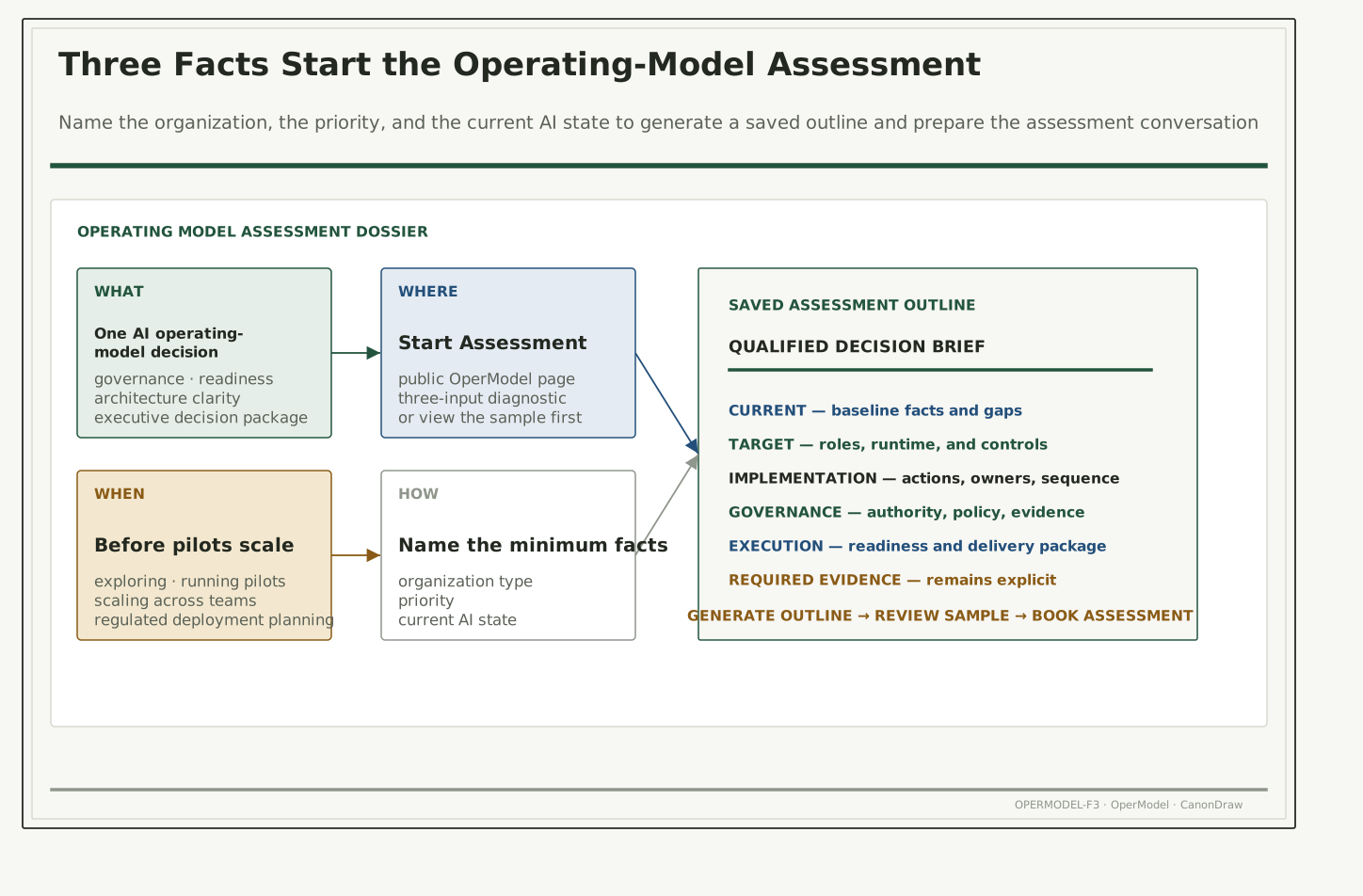
Select three inputs to save an operating model assessment outline.

Organizations are deploying AI without an operating model.

Pilots move faster than authority, risk ownership, runtime design, validation, and delivery planning. OperModel gives enterprise teams a way to see what exists, what should exist, what must be approved, and what has to be built.

OperModel creates the operating model layer around AI implementation.

CurrentTargetImplementationGovernanceDecision Package

Traceable outputs generated by the Models platform.

This sample is the CDX-024 CanonDocs publication for the Enterprise Knowledge Assistant operating model. It demonstrates the output format and evidence chain, not a completed real-customer pilot; unknown or absent pilot data is left explicit instead of filled in with invented claims.

CanonDraw system architecture diagram for the Enterprise Knowledge Assistant operating model
CanonDraw system diagram: 25 nodes and 26 edges.
CanonDocs reportOpen full sample

Published Full Report v1.0.0

Enterprise Knowledge Assistant Operating Model

  • Executive Summary
  • Operating Model Specification
  • Engineering Guide
  • Governance Handbook
  • Appendix with evidence references

Source snapshot includes diagnostic, architecture, runtime, validation, governance, implementation, executive decision, and cost artifacts. CDX-023 pilot evidence is not present, so customer-specific findings remain out of scope for this sample.

One workflow from discovery to delivery.

  1. Discover

    The diagnostic collects organization type, operating-model priority, and current state, then reads the platform source snapshot to establish the Current Operating Model as the factual baseline every later decision is measured against.

  2. Design

    Target roles, controls, runtime, and delivery path are laid out beside the current state. The Operating Model Delta surfaces before, after, and difference for each section so executives see exactly what must change before approving implementation.

  3. Decide

    In Executive Mode, business, risk, timeline, and cost are visible in one panel. Reviewers approve, reject, or request revision section by section, and every status change is written to a device-local audit history.

  4. Govern

    Governance carries authority, rules, assumptions, and the approval path in place. Human approval, audit trail, classification, and export provenance stay required so a decision can be reviewed with its source boundary intact.

  5. Deliver

    Readiness ties status to evidence, assumptions, and dependencies, and the Implementation section inherits recorded section approvals. The reviewed package exports as JSON, PDF, and an evidence manifest for the delivery team.

Teams that need evidence before scaling AI.

EnterpriseTransformation teams moving AI pilots into governed production with accountable owners.
GovernmentRegulated deployment planning where authority, audit trail, and approvals must be explicit.
ConsultingAssessment artifacts clients can review and approve section by section, not just receive as a deck.
IndustrialRuntime readiness gates checked before AI scales across operations.
EducationArchitecture clarity and traceable evidence before an institution-wide rollout.

OperModel is the commercial front door for the Models platform.

It uses the platform workflow already built across diagnostics, architecture, runtime planning, governance, implementation planning, executive decision support, CanonDraw, and CanonDocs.

A foundation for traceable enterprise assessment, not a security certification.

OperModel records workspace ownership, classification, provenance, audit history, and export metadata so assessment artifacts can be reviewed with their source boundary intact. It does not claim production identity integration, encryption-key management, runtime tenant isolation, or compliance certification.
Storyboards

The operating model, drawn from the evidence.

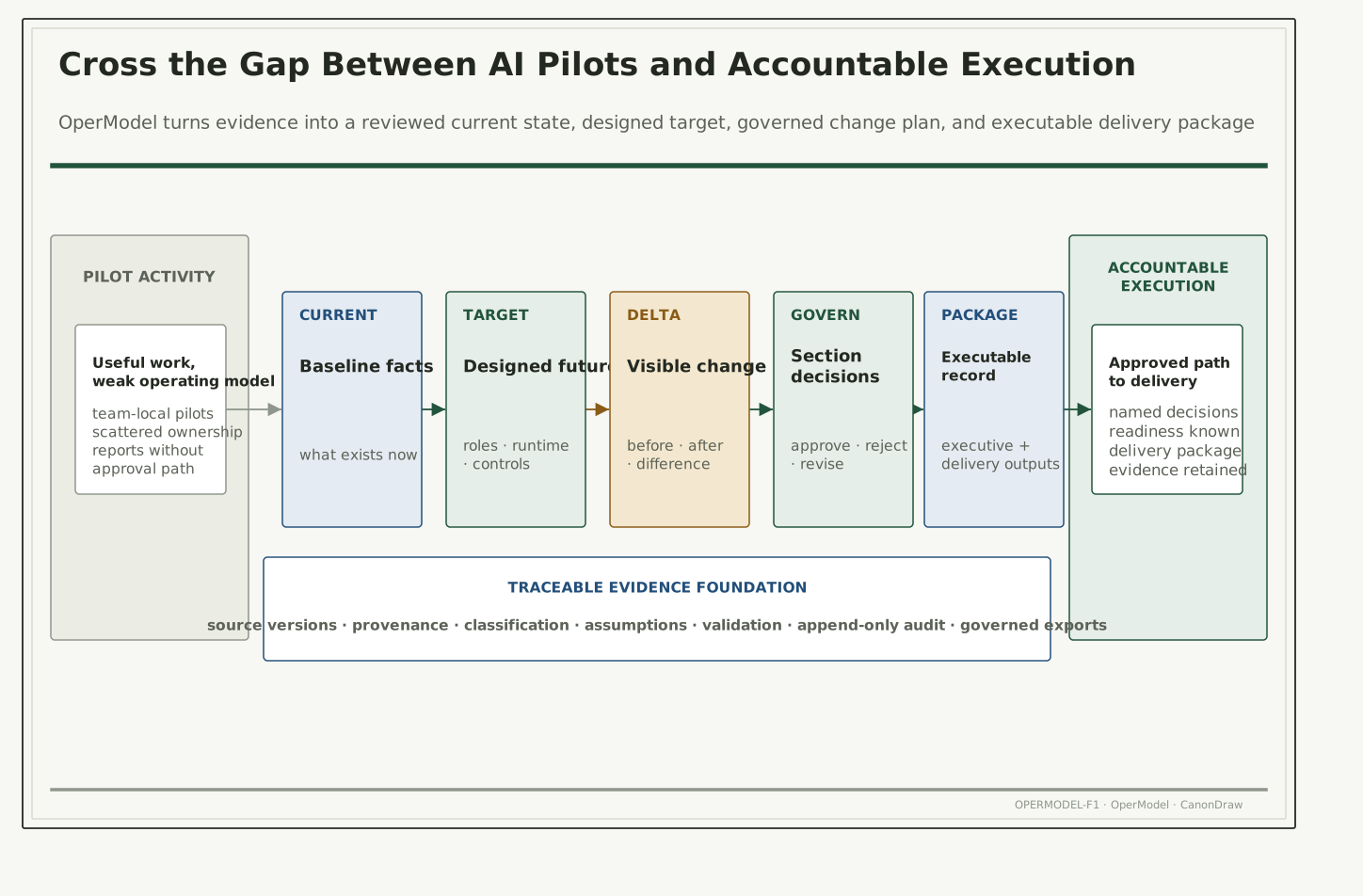
OperModel establishes the current state, designs the target, exposes the delta, governs section decisions, and delivers an executable package on a traceable evidence foundation.
OperModel establishes the current state, designs the target, exposes the delta, governs section decisions, and delivers an executable package on a traceable evidence foundation. · Edit in CanonDraw ↗
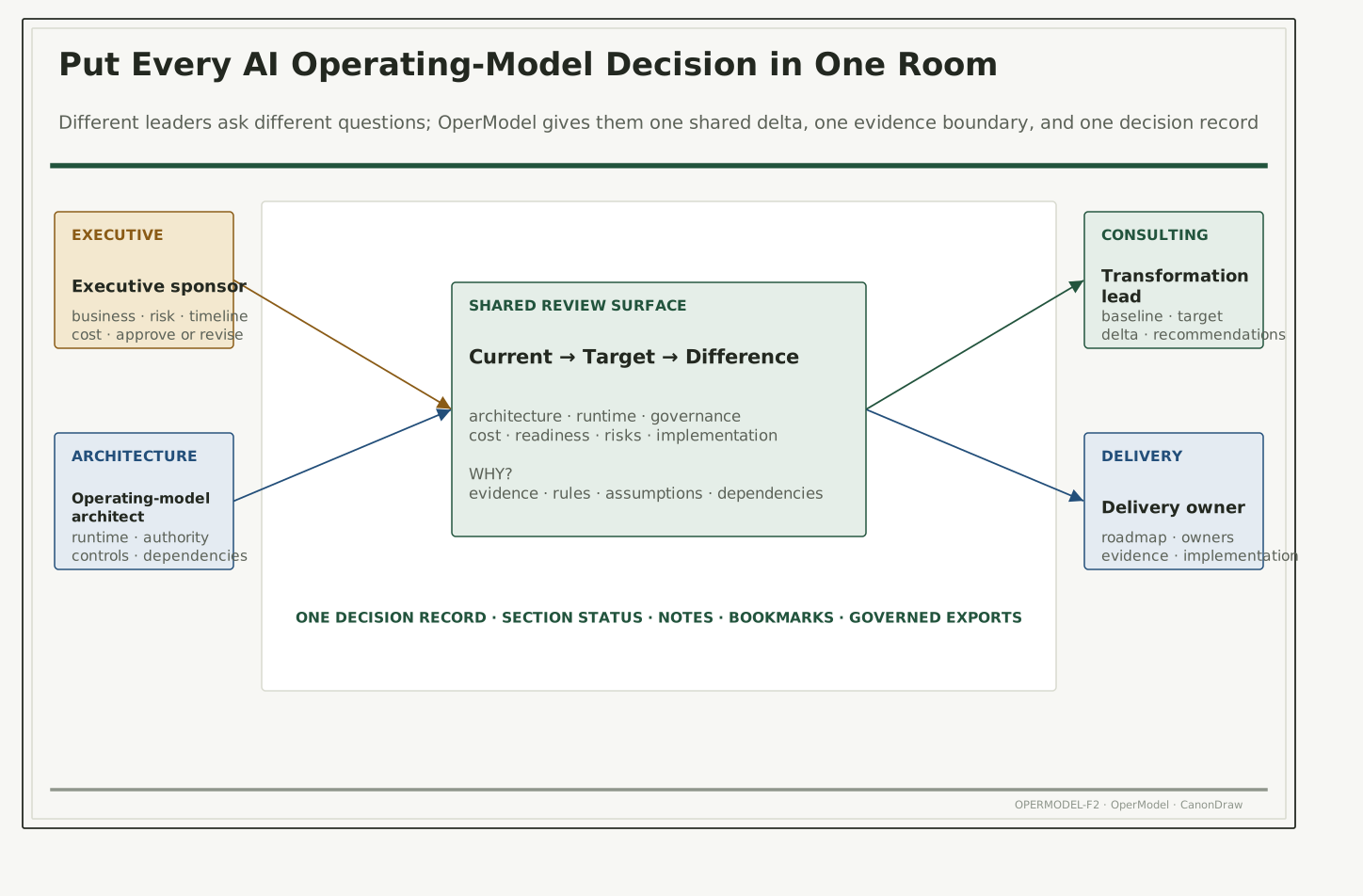
Executives, architects, transformation leaders, and delivery owners review the same current state, target state, delta, evidence, and section decisions in one operating-model workspace.
Executives, architects, transformation leaders, and delivery owners review the same current state, target state, delta, evidence, and section decisions in one operating-model workspace. · Edit in CanonDraw ↗
Choose the organization type, operating-model priority, and current state to save an outline; then review the sample and submit the decision your organization needs to make.
Choose the organization type, operating-model priority, and current state to save an outline; then review the sample and submit the decision your organization needs to make. · Edit in CanonDraw ↗

Request an Operating Model Assessment.

Use this when your team needs an evidence-based path from AI ambition to accountable execution. Requests are captured in a first-party assessment queue for qualified follow-up.

⬡ AskanderWork with us·mini-model.orgincentivis.comvalgraf.comaskander.netweb4intelligence.orgagentontology.orgjsontology.comlinkcanon.com